
The Structure Behind Remix Training
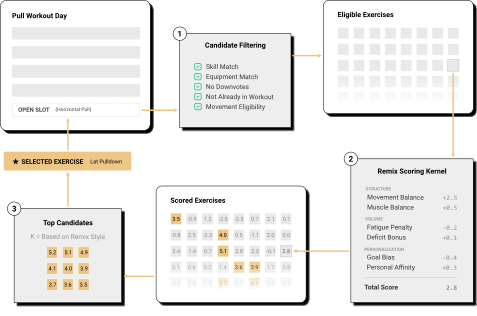
If you can't describe the rules, there isn't a method.
Most workout apps either rely on templates or shuffle exercises and call it personalization. Some use the word "AI" without explaining what rules are actually being followed.
Remix Training is built around defined, evidence-based constraints. Every exercise (whether it's generated from scratch or swapped later) goes through the same decision pipeline. There isn't one logic for building workouts and another for remixing them.
Structure Comes Before Everything
Before an exercise is ever scored for use in a workout - whether during split generation or a simple replacement - it has to pass structural enforcement.
These constraints operate at both the day level and the weekly plan level. They ensure foundational movement patterns are represented across the week, prevent over-duplication of key muscle groups, and cap certain exercise categories.
If an exercise candidate violates structure, it's removed entirely from consideration. It doesn't matter how well it might score, or how popular it is. Structure always wins.
To prevent long-term drift, the system maintains a running plan (or split) state that tracks movement counts, muscle emphasis, and what's already been used. That means the week stays coherent, and not just the individual workout.
Context Filters, Then Multi-Factor Evaluation
After structural exclusions, exercises are next filtered by context:
- Skill level must match
- Equipment must match
- Previously rejected exercises are excluded
- Duplicates within the day (and typically the week) are prevented
Replacement prioritizes preserving movement identity before widening the search. Additions must align with the day's movement intent. Both structure and context feed into the same unified evaluation engine that ultimately decides what appears in your workout.
That evaluation protects against specific failure modes:
| Evaluation Area | What It Protects Against |
|---|---|
| Movement Alignment | Breaking day structure during swaps |
| Pattern Saturation | Overusing the same movement across the split |
| Muscle Balance | Overemphasizing already dominant muscle groups |
| Fatigue Compatibility | Overloading a workout with excessive intensity |
| Plan-wide Repetition | Duplicating exercises across the day or week |
| Goal Alignment | Drifting away from the selected objective |
| Personal Affinity | Ignoring your feedback |
These dimensions produce a ranked list of eligible exercises.
Randomness only enters at the final step, and only then within the highest-ranked candidates, depending on your selected Remix Style. It does not randomize the entire pool.
Goals Have Structure
Training goals in Remix Training aren't cosmetic labels. Each goal is defined by a structured profile that changes how workouts are generated. As a muscle accumulates stimulus, the marginal benefit of adding more volume decreases. Remix models that effect and adjusts accordingly.
This protects against two common problems:
- Piling additional volume onto already used muscles
- Letting under-targeted muscles continue to be ignored
Goal logic influences:
- Weekly muscle and movement expectations
- Balance and symmetry weighting
If you change your goal, the plan regenerates. This keeps your workouts balanced, but still fitting your preferences.
Personalization But With Guardrails
User input matters, but it operates within boundaries.
Remix Training tracks exercise affinity, feedback, and locking behavior. Disliked exercises won't keep resurfacing. Preferred ones receive a measurable lift. Locked exercises are protected from automatic replacement.
But preference never overrides structural integrity.
During full-day remix operations, the system performs a stabilization pass after replacements occur. It validates the updated workout, checks for structural violations, and applies bounded corrections if necessary. Corrections can't introduce new violations and can't break movement identity.
Every exercise decision is followed by its own verification.
We aren't a template library, a random shuffle button, or a black box.
Remix Training was built as a rule-driven system that protects your workout balance first, then adapts to you - every time you generate or replace a workout.